
Trailering Your Boat: Choosing The Right Trailer And Tow Vehicle
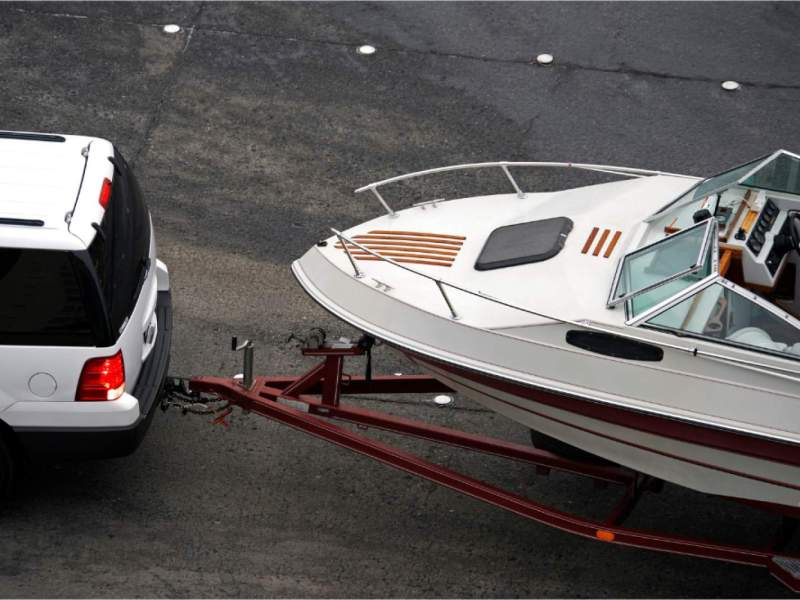
Buying the boat is the easy part. Getting it home, and then getting it to the ramp every weekend after that, comes down to two things: the trailer underneath it and the vehicle in front of it. Get either one wrong and you are looking at anything from a fine on the side of the road to a genuinely dangerous situation on the highway. Get them right and towing becomes the least stressful part of boat ownership.
Choosing the right trailer starts with your boat's all-up weight, including motor, fuel and gear, not just its dry weight from the brochure. That figure determines the trailer's required Gross Trailer Mass (GTM) and whether it needs brakes (mandatory above 750kg in every state). Your tow vehicle then needs to clear three separate limits, not just one: its braked towing capacity, its Gross Combination Mass (GCM), and its tow ball mass limit. All three must be satisfied at once, and the lowest-rated component in the whole chain, whether that's the vehicle, the towbar or the trailer coupling, sets your real legal limit. Every trailer also needs registration, safety chains rated to its mass, and correctly working lights, regardless of the state you are in.
Working Out What Your Trailer Actually Needs to Carry
Before you even look at trailers, weigh (or accurately calculate) your boat's fully loaded weight: hull, outboard, full fuel tank, battery, anchor and chain, safety gear, and anything else that normally lives on board. Boat manufacturers' dry weight figures rarely include any of this, and it adds up quickly. A boat listed at 900kg dry can easily be pushing 1,150kg once it is fuelled and rigged. Your trailer then needs an Aggregate Trailer Mass (ATM), which is the combined weight of the trailer and its full payload, that comfortably exceeds this figure. A trailer running right at its limit leaves no margin for extra gear, a full esky, or simply misjudging the boat's true weight.
When brakes are required
The rules are consistent across NSW, Queensland, Victoria and most other states:
- Trailers up to 750kg GTM: no legal requirement for brakes, but registration and number plates are still required.
- Trailers between 751kg and 2,000kg GTM: brakes are mandatory on at least one axle. A mechanical override (surge) system is the common, cost-effective option here.
- Trailers over 2,000kg GTM: brakes are required on all wheels, and larger trailers typically need electric or hydraulic brakes wired to a controller in the tow vehicle.
If you're buying secondhand, do not assume the trailer's braking setup is adequate just because it came with the boat. Check the compliance plate and confirm the GTM against what you actually intend to carry.
Matching a Tow Vehicle to the Job
This is where most trailer boat combinations come unstuck, not because the vehicle cannot physically pull the weight, but because one of three separate limits gets overlooked.
- Braked towing capacity: this is the headline marketing figure manufacturers advertise, and the one most buyers check first. It is not, on its own, enough.
- Gross Combination Mass (GCM): GCM is the maximum combined weight of your fully loaded vehicle and fully loaded trailer together. A vehicle might be rated to tow 3,000kg, but if it is already close to its own GVM with passengers, fuel and gear on board, the GCM limit can leave far less towing capacity available than the advertised figure suggests. This is the number that catches out families towing with a fully loaded 4WD.
- Tow ball mass (TBM): the downward pressure that the trailer applies onto the tow ball, typically around 10 per cent of the trailer's total loaded weight, adds directly to your vehicle's payload and counts against its GVM. Too little TBM causes the trailer to sway; too much TBM overloads the back of your tow vehicle.
The rule that ties all of this together: your legal towing limit is set by whichever number in the chain is lowest, whether that is the vehicle's rating, the towbar's rating, or the trailer coupling's rating. A 3,500kg-rated vehicle with a 2,000kg-rated towbar can only legally tow 2,000kg.
Registration, Chains and the Legal Basics
Regardless of size, every boat trailer on New Zealand roads needs:
- Current registration and number plates, even for trailers under 750kg that don't require brakes.
- At least one safety chain (two for trailers over 2,500kg GTM), rated to the trailer's mass and correctly crossed under the coupling.
- Working tail lights, brake lights and indicators, wired to match the tow vehicle.
- A coupling rated to at least the trailer's GTM.
Speed limits while towing generally follow the posted limit, though NSW imposes a 100km/h cap when the combination's GCM exceeds 4,500kg, and Western New Zealand and Tasmania cap towing speed at 100km/h more broadly. If you are planning an interstate trip, it is worth checking the current rules for every state you will pass through, as they are not identical.
A Simple Pre-Purchase and Pre-Trip Checklist
Before you buy a trailer
- Calculate your boat's fully loaded weight, not the dry weight.
- Choose a trailer ATM with a safety margin above that figure.
- Confirm the braking requirement for that weight class and check the trailer meets it.
- Check your tow vehicle's GCM and TBM ratings, not just its advertised towing capacity.
Before every trip
- Check tyre pressures on both the trailer and tow vehicle.
- Inspect wheel bearings, suspension and brakes, particularly after saltwater launches.
- Confirm all lights are working and safety chains are correctly attached.
- Double check the boat and any loose gear is properly secured for the drive.
A well-matched trailer and tow vehicle should be the part of boat ownership you never have to think about twice. Take the time to get the weights right, confirm your vehicle is genuinely rated for the job, and keep the trailer's safety basics in good order, and every trip to the ramp becomes routine rather than risky.
If you are still shopping for your first boat, or looking to upgrade to something that will need a heavier-duty setup, browse current trailer listings on Boats Online to ensure you can get your new boat home.
Frequently Asked Questions
Do I need a special licence to tow a boat trailer in New Zealand?
No separate licence is required to tow a standard boat trailer under 4.5 tonnes GCM on a regular car or light truck licence. Larger combinations that push the total GCM above 4.5 tonnes may require a higher licence class, so it is worth checking your specific vehicle and trailer combination if you are towing something substantial.
How do I find out my vehicle's actual towing capacity?
Check the compliance plate, usually fitted to the driver's door frame, or the owner's manual, which will list the braked towing capacity, GCM and tow ball mass limit. If you bought the vehicle secondhand with a towbar already fitted, confirm the towbar's own rating separately, as it may be lower than the vehicle's factory rating.
What happens if I tow a trailer that's over my vehicle's rated capacity?
It is illegal, and if you are involved in an incident while over your rated limit, your insurance may not cover the damage. Police can also issue fines for towing an overloaded or non-compliant combination, and in serious cases the vehicle can be defected on the spot.
Can I use the same trailer for a bigger boat if I upgrade later?
Only if the trailer's ATM comfortably exceeds the new boat's fully loaded weight and the braking system meets the requirement for that weight class. It is common for boat owners to upgrade the boat but keep an undersized trailer, which is both unsafe and easy for authorities to pick up on.
Do electric brakes need a separate controller fitted to my car?
Yes. Electric brake trailers require a brake controller wired into the tow vehicle, which sends a signal to the trailer brakes in sync with the vehicle's own braking. This is a common aftermarket fitment on 4WDs and utes used for towing larger trailer boats.